
Beyond the Bomb: What Really Separates Indian and Pakistani Strategic Thinking

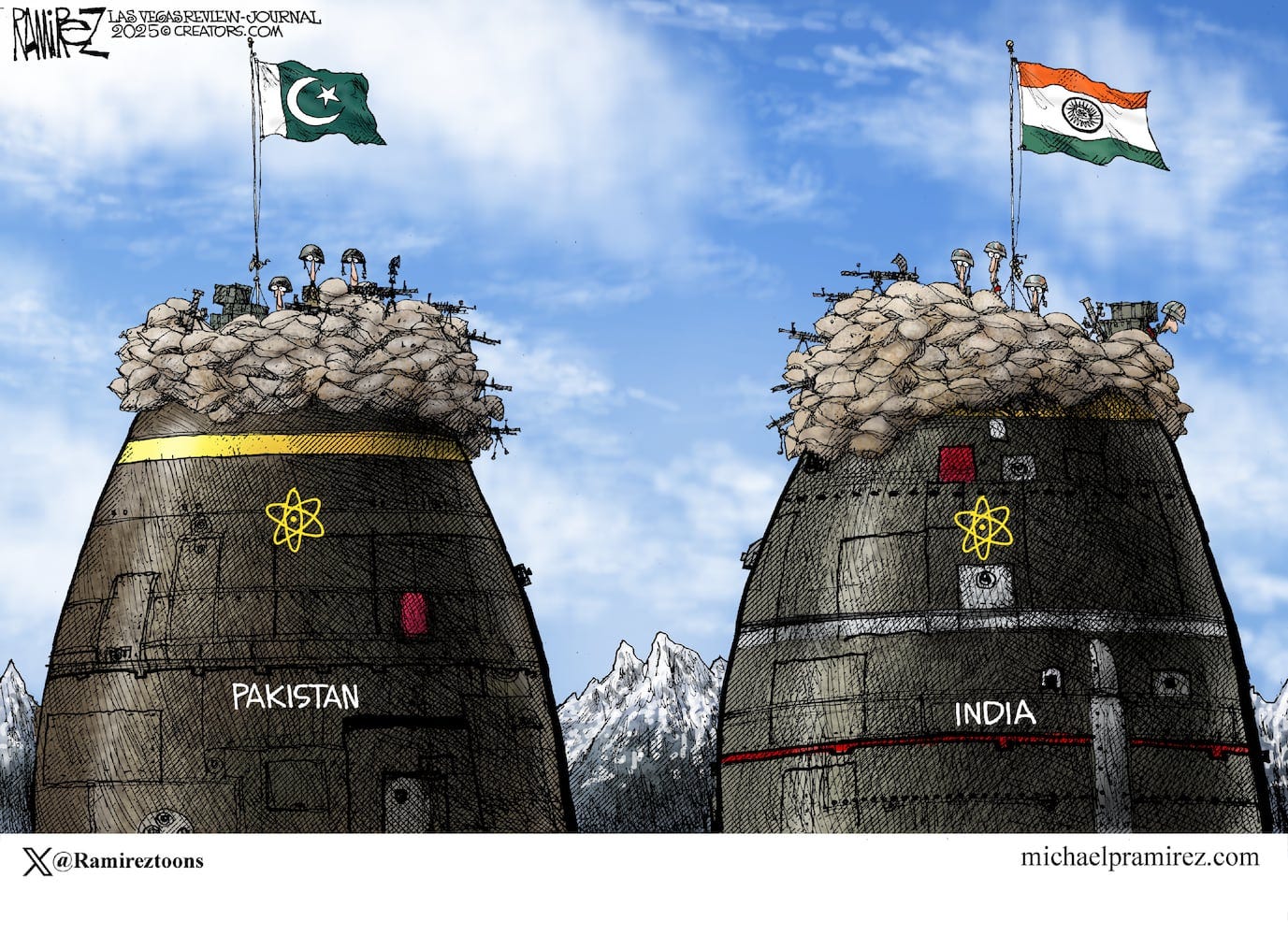
Why Strategic Culture Still Matters
You can often tell how a state thinks about war by how it prepares for peace.
In South Asia, the shadow of conflict hangs heavy, yet the ways India and Pakistan imagine security are shaped by entirely different instincts. One leans toward demonstrating strength to deter weakness; the other builds layered defenses to deny the illusion of space for conflict. The weapons may be similar, the crises familiar but the logic behind each move is not.
Strategic culture isn’t just a backdrop. It shapes how policymakers interpret silence, read intent, and decide when restraint is wisdom and when it is risk. And in a region where misreading the other can lead to catastrophe, understanding these divergent scripts is no longer optional for us, it is absolutely essential.
Despite geographic proximity and a shared colonial past, India and Pakistan have developed divergent strategic temperaments. These are not merely tactical differences; they reflect deeper assumptions about power, legitimacy, and identity. As the May 2025 crisis once again revealed, misreading the other’s strategic culture can be dangerous.
Historical Origins of Strategic Culture
Strategic cultures are shaped by formative traumas, intellectual traditions, and existential choices. India and Pakistan exemplify two very different lineages of strategic thought.
India: Strategic Patience and Civilizational Aspiration
India’s strategic culture is shaped by its civilizational self-image and a long-held belief in its status as the dominant regional power. While Kautilya’s Arthashastra is often cited as a source of realist statecraft, in practice, India’s early strategic behavior was guided by Nehruvian principles, non-alignment, idealism, and a preference for what they call ‘strategic restraint’. But restraint in Indian strategic thinking is selective. It coexists with doctrines like Cold Start and with strikes across the LoC and mainland Pakistan. While India often invokes the language of restraint, it leaves room to shift gears especially when internal political dynamics, public sentiment, or a sense that deterrence is slipping demand a more forceful response.
In that sense, Indian strategic restraint is less a fixed principle and more a flexible posture used to manage perceptions, control escalation, and reinforce its image globally, even while leaving space for calibrated military action.
India's post-1971 confidence and the 1974 nuclear test signaled a shift towards status-seeking. India's wars with China (1962) and Pakistan (1965, 1971, 1999) shaped a gradual shift from moral restraint to assertive realism. Its embrace of Cold Start doctrine and cross-border strikes after 2016, 2019 and May 2025 reflects a willingness to push thresholds while maintaining plausible deniability.
Pakistan: Security Dilemma, Existentialism, and Reactive Deterrence
Pakistan’s strategic culture emerged from the trauma of Partition, early military engagements, and the breakaway of East Pakistan in 1971. These experiences fostered a survival-driven mindset, in which nuclear weapons were seen as vital to ensuring the country’s existential security.
From Bhutto’s catalytic vision to today’s full-spectrum deterrence, Pakistan has cultivated a responsive posture where the aim is denial and not dominance. Its strategic community places a premium on signaling resolve, deterring escalation through calculated ambiguity, and preempting Indian doctrinal adventures.
Civil-Military Relations and Their Impact
In India, the civilian primacy has ensured a measured approach to strategy-making, often characterized by slow doctrinal adaptation and bureaucratic diffusion of responsibility. Strategic choices are filtered through electoral politics, inter-service competition, and policy inertia. The military has a voice, but it is not the dominant one.
In Pakistan, the military is the nucleus of strategic thinking. Civilian input exists but is secondary, especially on core issues of deterrence, India policy, and nuclear doctrine. This gives Pakistan a quicker strategic reflex during crises, but it also reinforces the centrality of the military in shaping how the state defines its security priorities and national identity.
The result? India often thinks strategically but acts slowly. Pakistan acts quickly but remains doctrinally consistent. This asymmetry can produce misread signals during crises.
Risk Acceptance and Escalation Thinking
India has shown growing risk appetite, particularly in the post-Balakot era. The embrace of limited, publicly acknowledged strikes such as in May 2025, signals a willingness to test Pakistan's red lines. Strategic thinking here often involves creating escalation dilemmas for Pakistan.
Pakistan, by contrast, has relied on calibrated deterrence, designed to signal resolve without rushing to escalate. Its full-spectrum deterrence posture aims to deny India the space for launching full-scale conventional war by making any military gamble costly. In May 2025, the absence of early nuclear signaling reflected growing confidence in Pakistan’s conventional preparedness and political maturity. Restraint was a choice. But the Indian assumption that lack of nuclear signaling meant it called Pakistan’s ‘nuclear bluff’ reveals more about India’s risk appetite than any failure in Pakistan’s posture.
These diverging instincts reflect strategic cultures shaped by very different relationships with war and victory.
Role of Strategic Restraint and Image-Building
India sees itself as a rising global power. Strategic restraint is often framed as a function of status and international legitimacy. It seeks recognition in global nuclear hierarchies and aligns its posture to that aspiration.
Pakistan's strategic restraint is born of necessity. It does not have the luxury of appearing weak. Unlike doctrines built around ambiguity or passive deterrence, Pakistan’s signaling is purposeful designed to communicate resolve precisely when it matters. For Pakistan, image-building is not about seeking international validation; it’s about demonstrating credibility in moments of crisis.
Let’s say: where India restrains for prestige, Pakistan signals for deterrence.
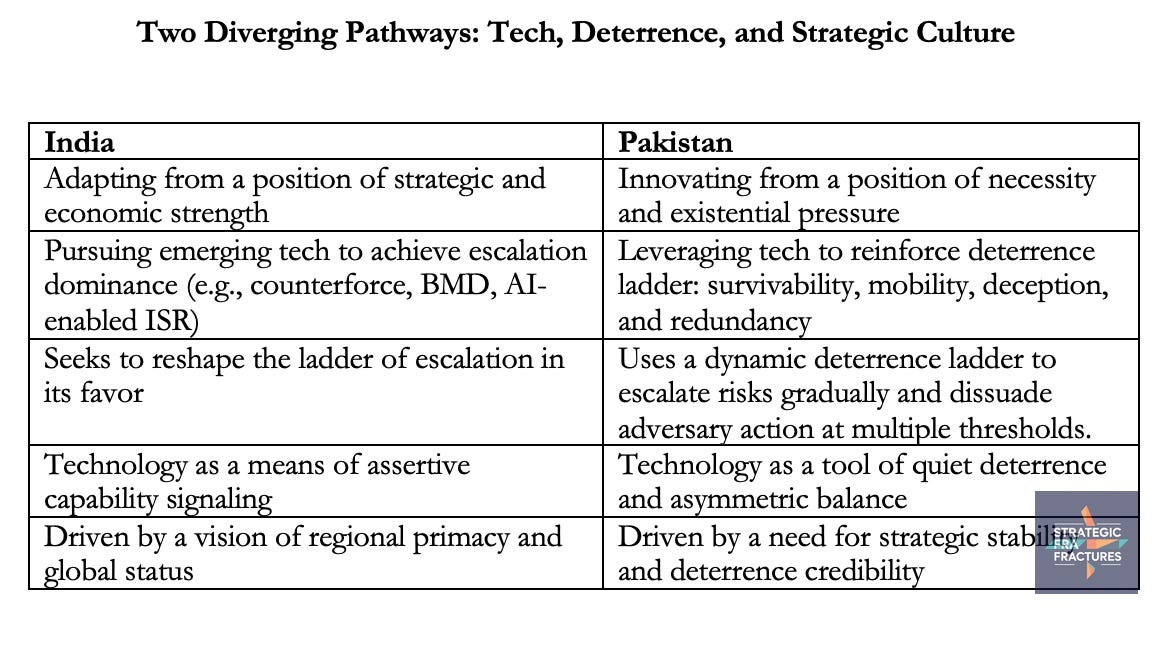
As emerging technologies blur the lines between conventional and nuclear thresholds, India and Pakistan are moving in very different directions: one to dominate, the other to deny. The table below maps how their strategic cultures shape their approach to tech-infused deterrence.
Emerging Technologies and Diverging Futures
India is investing in counterforce, missile defense, AI-enabled ISR, and space capabilities. Its pursuit of strategic autonomy includes mastering new domains and building escalation dominance.
Pakistan, facing resource constraints, focuses on survivability and offsetting tools: MIRVs, tactical nukes, improved mobility, and deception. It seeks to re-balance deterrence, not dominate it.
As emerging tech redefines deterrence, India is adapting from a position of strength. Pakistan is innovating from a position of necessity. Both are shaping the region’s future risk landscape in profoundly different ways.
Beyond the bomb lies something even more dangerous when misunderstood:the mind behind it.
Understanding the Mind to Avoid the Misstep
The next crisis in South Asia will not be decided by warheads alone. It will be shaped by how each side thinks about escalation, signals intention, and interprets restraint.
To read each other better, India and Pakistan must first understand that their strategic cultures are not mirror images. They are asymmetrical, layered, and rooted in distinct national experiences.
For a deeper understanding on strategic culture, read some of the classics. Here are some links for you to explore: The Soviet Strategic Culture : Implications for Limited Nuclear Operations by Jack Snyder ; Strategic Culture and American Empire by Theo Farrell; Comparative Strategic Culture by Colin S. Gray; Pakistan’s Strategic Culture by Hasan-Askari Rizvi; Indian Strategic Culture by Kanti Bajpai; China and Strategic Culture by Andrew Scobell
This is one of the finest pieces that doesn't employ run of the mill tropes on strategic cultures of Pakistan and India. Glad to engage and reflect on it.
Excellent writeup on this sensitive issue. Thanks for sharing